News Center
Innovative Solution Provider for Minimally Invasive Surgery

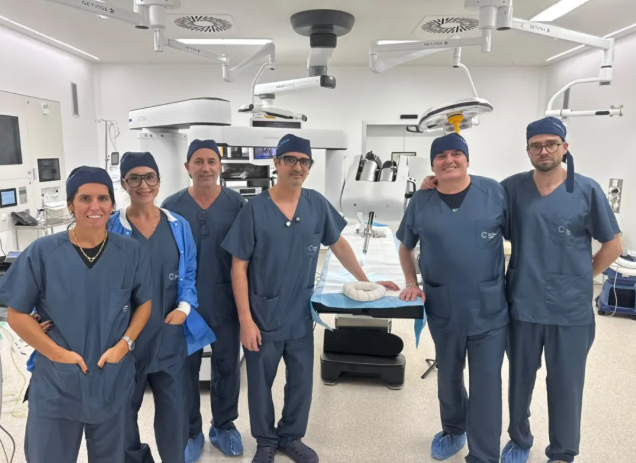
Recently, the Edge® Single-Port Endoscopic Surgical Robot SP1000 completed its first clinical application in European thoracic surgery at Hospital Memorial Publio Cordón in Madrid, Spain. On the same day, the hospital's thoracic team — led by Dr. Diego González Rivas, a globally recognized pioneer of uniportal thoracoscopy — performed two consecutive pure single-port robot-assisted thoracic procedures that together addressed two of the classic challenges of single-port robotic surgery: the first required a large-span operation reaching from the right lower lobe basal segment all the way to the pleural apex, and the second an anatomic segmentectomy completed in a constrained space marked by pleural adhesions, poor lung deflation and an intercostal space of less than 2 cm. Both cases demonstrated the operational adaptability of the Edge® single-port robot across very different thoracic scenarios.
This milestone marks a significant step in the international clinical adoption of the Edge® single-port robot, and creates a new opportunity for the deep integration of China's home-grown single-port surgical robotics with the frontier of international thoracic surgery.
A Pioneer of Uniportal VATS Leads
Partnering with a Distinguished European Thoracic Team
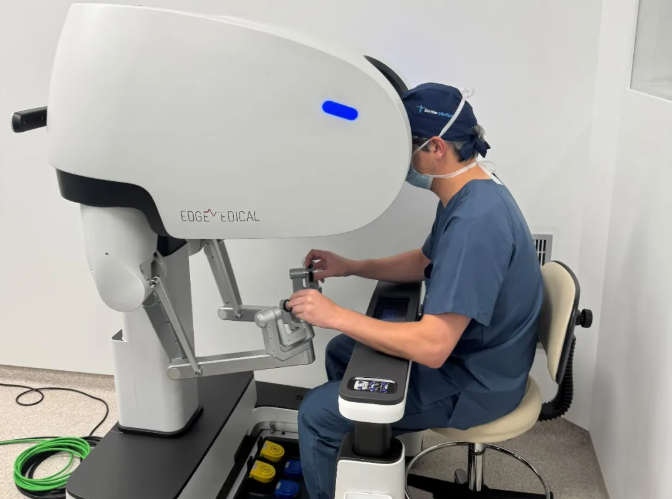
Dr. Diego González Rivas performed the procedures. As one of the pioneers of uniportal thoracoscopy worldwide, he has devoted his career to advancing and promoting minimally invasive thoracic surgery, and he has built wide international influence in the field of single-port thoracoscopy.
At Hospital Memorial Publio Cordón, the department of thoracic surgery is renowned for uniportal VATS and robot-assisted thoracic surgery, and it hosts a dedicated minimally invasive robotic thoracic surgery unit led by Dr. Diego González Rivas.
This convergence of clinical expertise, a dedicated specialty unit and an innovative surgical platform created the ideal professional environment for the Edge® SP1000's European thoracic debut, and it reflects the strong interest of international clinical experts in exploring and adopting single-port robotic technology.
Two Pure Single-Port Procedures
Demonstrating Potential in Complex Thoracic Scenarios
Thoracic surgery is defined by complex anatomy and a confined operative field. Managing critical structures — hilar vessels, bronchi and intersegmental planes — in particular, demands exceptional instrument dexterity, operating range and precision from the surgical robot.
Across two different lesion locations and complex intrathoracic conditions, the Edge® SP1000 demonstrated strong operational adaptability and technical performance, completing both procedures successfully through a pure single-port approach.
Case 1: Right Lower Lobe Wedge Resection with Lymph Node Biopsy
The patient was an elderly man with a ground-glass nodule in the right lower lobe. Using the Edge® SP1000 through the 9th intercostal space on the mid-axillary line, Dr. Diego González Rivas completed a single-port robot-assisted right lower lobe wedge resection with mediastinal lymph node biopsy (groups R2 and R4). The incision measured approximately 4 cm, operative time was approximately 20 minutes, and intraoperative blood loss was minimal.
The principal challenge in this case was the wide span between operative sites. The lesion lay in the right lower lobe basal segment, while the lymph nodes sat above and below the azygos arch near the pleural apex. Intraoperatively, the surgeon used the system's re-positioning function to move the DriveBox, with its instruments, from the lower lobe near the diaphragm up to the pleural apex, switching flexibly between operative fields and demonstrating the wide range of motion of the Edge® single-port robot's arm. Because the case was approached through the 9th intercostal space on the mid-axillary line, the instruments had to support both close-range work at the lesion and distant reach to the pleural apex for nodal biopsy — a demanding combination of working length and dexterity. In addition, the hilar lymph nodes lie in close proximity to the great hilar vessels, and their dissection demands both flexibility and precision. The SuperArm wrist joint integrated into the Edge® single-port instruments, together with precision control algorithms, delivered the flexible, finely controlled dissection required alongside those vessels.
Case 2: Right Upper Lobe S2 Segmentectomy with Hilar Lymph Node Dissection
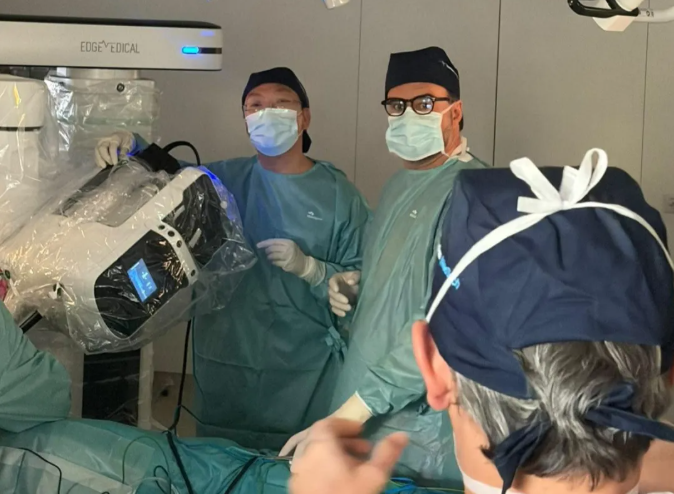
The second patient underwent surgery for a mass in the right upper lobe. Through the 7th intercostal space on the mid-axillary line, Dr. Diego González Rivas completed a single-port robot-assisted right upper lobe S2 segmentectomy with hilar lymph node dissection using the Edge® SP1000. The incision measured approximately 4 cm, the procedure took approximately 50 minutes, and intraoperative blood loss was approximately 20 mL.
This patient presented with pleural adhesions and pulmonary fibrosis, and the lung was poorly deflated intraoperatively, markedly reducing the available thoracic working space. At the same time, the intercostal space at the access site measured less than 2 cm, challenging instrument motion and port adaptation within a narrow channel. The special structural design of the Edge® SuperArm instruments removes the need for wide elbow extension and helps the instruments work within confined spaces. In addition, the surgeon precisely set the remote center of motion, keeping the instruments and the endoscope under zero pressure throughout the procedure — demonstrating the value of remote center technology in a narrow intercostal approach.
Taken together — flexible reach across distant anatomical regions, instrument adaptability across a range of working distances, precise dissection in complex anatomy, and free movement with Remote Center Technology in a confined thoracic cavity — the two procedures demonstrate the technical characteristics and clinical potential of the Edge® SP1000 in complex thoracic scenarios.
Answering Clinical Needs Through Innovation
Expanding the Reach of Single-Port Surgery
The thoracic cavity is confined, yet the operative field is never a single point. For patients, the promise of single-port surgery is straightforward — a smaller incision, less postoperative pain and a faster return home. For physicians, it means precision in the most constrained operative fields. Balancing instrument range of motion, operational flexibility and port adaptation under a limited incision therefore remains a priority for single-port robotic technology, and a commitment Edge Medical continues to advance.
The Edge® Single-Port Endoscopic Surgical Robot is the first single-arm, single-port surgical robot approved for market in China. Its highly integrated “single-arm, single-port” design routes every instrument — three surgical instruments and a 3D endoscope — through a single port into the patient's body. Built around three proprietary technologies — Retractable Sleeve technology, AgileArm Technology and Remote Center Technology — the system directly addresses the clinical constraints of single-port surgery: limited space, constrained instrument range of motion and port compression.
In the first procedure, the cross-regional reach from the right lower lobe basal segment to the pleural apex demanded both longitudinal working length and lateral operating space. Retractable Sleeve Technology and AgileArm Technology expand that reach along the longitudinal and lateral axes respectively, and, together with intraoperative re-positioning, support flexible work at different depths and within different anatomical fields.
Facing the confined space created by pleural adhesions and poor lung deflation in the second procedure, the special structural design of the SuperArm instruments removes the need for wide elbow extension and helps the instruments operate within restricted spaces. And in an intercostal space of less than 2 cm, Remote Center Technology precisely sets the remote center of motion, keeping instruments and endoscope under zero pressure and reducing compression between the instruments and the port.
From flexible repositioning across distant anatomical regions, to instrument motion within a confined thoracic cavity, to zero-pressure operation through an intercostal approach, the engineering of the Edge® single-port robot responded closely to the real clinical demands of these two procedures — providing a practical reference for its application in more complex thoracic scenarios, where better working space supports better clinical outcomes.
From CE Mark to European Clinical Deployment
Advancing Internationalization to a New Stage
From market approval in China, to EU CE certification, to this first clinical deployment in European thoracic surgery, Edge Medical is moving China's home-grown single-port surgical robots from international market access into international clinical practice.
This milestone marks a significant advance in the application of the Edge® single-port robot within European thoracic practice, and it establishes a foundation for broader international clinical collaboration, the accumulation of overseas application experience and commercial deployment in the European market.
Looking ahead, Edge Medical will continue to work with clinical experts and partners worldwide, deepen international clinical exchange and collaboration, and advance surgical robotics across more countries, regions and clinical specialties — empowering minimally invasive surgery with innovation, so that physicians have the technology they trust and more patients can recover faster and get home sooner.

