News Center
Innovative Solution Provider for Minimally Invasive Surgery

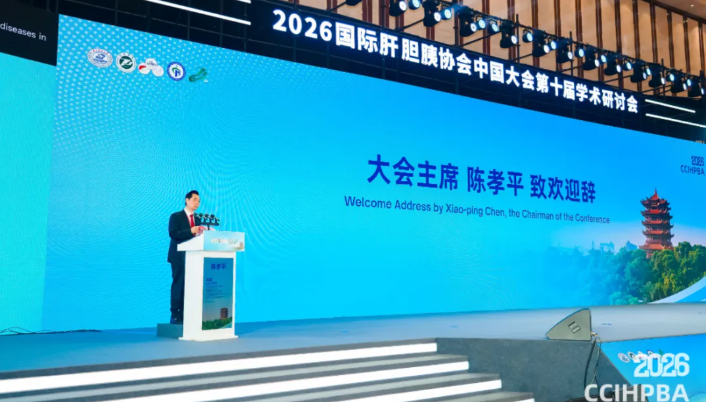
From May 18 to 24, the 10th Academic Symposium of the International Hepatobiliary and Pancreatic Association – China Chapter (IHPBA China Chapter) was held in Wuhan. During the congress, the "Robotic Telesurgery Broadcast Week," one of the event's key highlights, was launched for the first time. Multiple domestic and international surgical experts used Edge®'s surgical robot systems paired with the EdgeCloud® telesurgery system to complete 13 telesurgery broadcast demonstrations, achieving multi-point interconnectivity among Wuhan, Jingzhou, Beijing, Hefei, and Shanghai, covering gastrointestinal, hepatobiliary, urology, and thoracic surgery procedures. The network also crossed borders to connect with Uzbekistan, Georgia, and Greece, enabling cross-border telesurgeries and creating multiple first-time application breakthroughs in different regions. This marks a new stage where China's original high-end medical equipment is transitioning from single-point technological breakthroughs to cross-regional, cross-national, and cross-disciplinary collaborative application.
13 Telesurgery Broadcasts Connect China and the World
Accelerating Toward a New Stage of Global Clinical Collaboration
The IHPBA China Chapter was established in 2003 and has successfully held its biennial academic symposiums nine times since 2004, making it an important platform for hepatobiliary and pancreatic surgical academic exchange in China. This year's congress was hosted by Tongji Hospital affiliated to Tongji Medical College, Huazhong University of Science and Technology, bringing together multidisciplinary experts from hepatobiliary, pancreatic, urology, and general surgery fields domestically and internationally to jointly explore surgical technology innovation and clinical application advancement.
During the opening ceremony, Congress Chairman Chen Xiaoping, Academician of the Chinese Academy of Sciences and President of IHPBA China Chapter, reviewed the development journey of the China Chapter in his welcome address and outlined the important mission of this congress in deepening academic exchange and inspiring medical innovation. He particularly highlighted that a new round of technological revolution driven by artificial intelligence, 5G/6G communication, and robotics is deeply integrating with the healthcare industry. This model not only leads the direction of global medical technology transformation but also aligns closely with China's "Healthy China 2030" strategy goals of optimizing medical resource allocation and promoting the downward delivery of high-quality medical resources.
During the "Robotic Telesurgery Broadcast Week," Prof. Hu Junbo, Prof. Wang Guihua, Prof. Zhu Peng, Prof. Wang Shaogang, and Prof. Zhang Ni from Tongji Hospital affiliated to Tongji Medical College, Huazhong University of Science and Technology, along with specially invited domestic surgeons including Academician Zhang Xu from the Chinese PLA General Hospital, Prof. Shen Banyong from Ruijin Hospital affiliated to Shanghai Jiao Tong University School of Medicine, Prof. Zhang Qian from Beijing Shijitan Hospital affiliated to Capital Medical University, and Prof. Wang Shuai from Jingzhou Central Hospital, each completed multiple telesurgery broadcast demonstrations using Edge®'s surgical robot system.
At the same time, Dr. Abdurashid Abdukarimov, a general surgeon from Uzbekistan, Dr. Emzar Nadiradze, a general surgeon from Georgia, and Dr. Evangelos Liatsikos, a urological surgeon from Greece, also participated in cross-border telesurgeries through Edge®'s surgical robot and telesurgery system. This not only expanded the academic scope of the congress's surgical broadcasts but also showcased domestic surgical robot telesurgery collaboration capabilities in a broader international clinical setting.
Spanning 5,000 to 8,000 Kilometers
Edge®'s Telesurgery System Enters International Clinical Practice
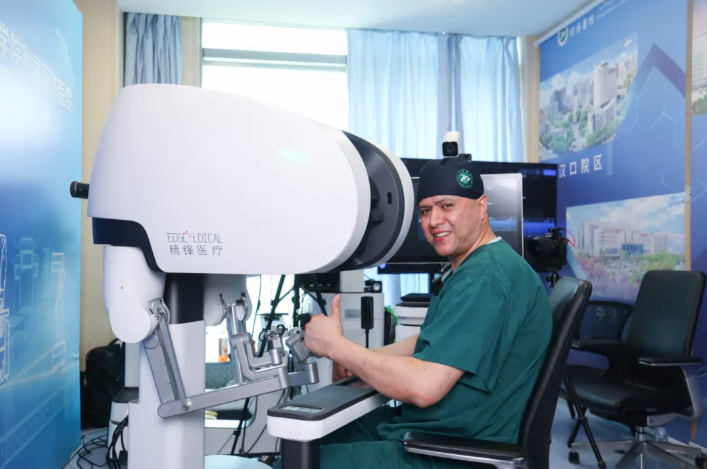
Dr. Abdurashid Abdukarimov from Uzbekistan completed a telesurgery-assisted laparoscopic cholecystectomy. After the procedure, he stated that this was a groundbreaking telesurgery for Uzbekistan.
"The surgery went very smoothly, and I am very excited. This is a great beginning. The introduction of China's robotic surgical system will make our surgeries more convenient, safer, and more patient-friendly." He stated that in the future, he plans to continue exploring telesurgery applications within Uzbekistan and further strengthen exchange and cooperation with Chinese hospitals and Chinese doctors.
Dr. Emzar Nadiradze, a general surgery expert from Madagleshvili Medical Center in Georgia, completed a telesurgery-assisted laparoscopic low anterior resection for rectal cancer. After completing the surgery spanning approximately 8,000 kilometers, he stated that robotics and telesurgery represent an important direction for future medical development and are also an important reflection of a nation's comprehensive medical capabilities.
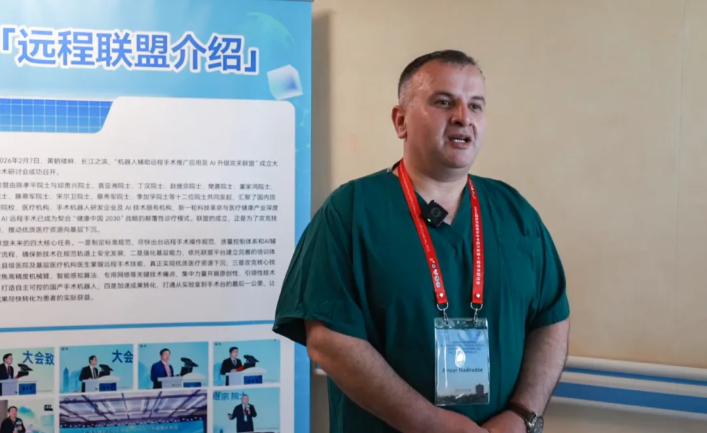
"Telesurgery can promote the integration and sharing of international medical resources, and we are grateful to Chinese medical institutions for providing this collaboration opportunity." It was reported that since introducing Edge®'s surgical robot from China last July, Madagleshvili Medical Center has completed 100 robotic surgeries, covering general surgery, gynecology, urology, and other disciplines, and will expand to more surgical procedures through exchange with Chinese experts in the future.
From domestic multi-point interconnectivity to cross-border telesurgery operations, this congress comprehensively demonstrated the stability and clinical adaptability of EdgeCloud® telesurgery system in complex network environments, long-distance transmission, and multi-disciplinary applications. Telesurgery is no longer limited to concept verification but is entering a comprehensive application stage encompassing real clinical practice, academic exchange, international collaboration, and medical resource sharing.
Academic Forum Focuses on Telesurgery and AI Advancement
Driving Technology Innovation Toward Clinical Standardization
At the "Second Meeting of the Alliance for Promoting Application of Robot-Assisted Telesurgery and AI Upgrading Research" held during this congress, multiple experts shared telesurgery clinical and research cases using Edge®'s surgical robot system, showcasing the comprehensive strength of domestic surgical robots in technological innovation, clinical transformation, and academic research from different dimensions.
Academician Zhang Xu from the Chinese PLA General Hospital, with the topic "Exploration and Breakthroughs in Telesurgery Clinical Research," shared experience in the systematic development of telesurgery from exploration to clinical research; Prof. Wang Shaogang from Tongji Hospital affiliated to Tongji Medical College, Huazhong University of Science and Technology, with the topic "Application of Telesurgery Robotics in Urology," introduced progress in telesurgery robot applications in urological settings; Prof. Li Yong from Guangdong Provincial People's Hospital, with the topic "Telesurgery Robotic Colorectal Cancer Surgery," shared clinical practice of telesurgery robots in gastrointestinal oncological surgery; Prof. Zhu Peng from Tongji Hospital affiliated to Tongji Medical College, Huazhong University of Science and Technology, with the topic "Telesurgery Robotic Liver Resection," presented exploration achievements of telesurgery robots in complex hepatobiliary surgery.
From telesurgery urology and telesurgery colorectal cancer surgery to telesurgery liver resection and cross-border general surgery, this forum, together with the surgical broadcasts, formed a complete closed loop of "clinical demonstration + academic discussion + research exploration," providing important references for future standardization of telesurgery, expansion of indications, quality control, and multi-center research.
From Chinese Innovation to Global Sharing
Telesurgery Opens New Space for Medical Collaboration
From domestic regional medical collaboration to cross-border telesurgery exploration; from complex clinical scenario validation to academic alliance-driven standardization; from single-point technological breakthrough to continuous global telesurgery practice—Edge®'s robots are driving telesurgery from "achievable" to "replicable," from "Chinese Innovation" to "Global Sharing" through sustained clinical practice.
In the future, as artificial intelligence, communication networks, robotic control, and clinical medicine continue to converge, telesurgery is expected to play an even greater role in expanding access to quality medical resources, treating major diseases, advancing international medical collaboration, and cultivating surgical talent.

