News Center
Innovative Solution Provider for Minimally Invasive Surgery

On June 4, 2026 (Rome time), at the 22nd Congress of the International Society of Laparoscopic and Robotic Surgery Challenges and Artificial Intelligence (CILR), a high-complexity remote robotic procedure spanning the European and Asian continents was broadcast live to urological surgeons worldwide.Professor Huang Qingbo of the Chinese People's Liberation Army (PLA) General Hospital, positioned in Rome, Italy, used the Edge Cloud® remote surgery system to control the Edge Medical® surgical robot in a Beijing operating room approximately 8,200 kilometers away — successfully completing the world's first intercontinental remote tumor thrombectomy with inferior vena cava (IVC) reconstruction.
This follows the trailblazing 2024 live intercontinental telesurgery by Academician Zhang Xu using the Edge Medical® robot — the world's first intercontinental ultra-remote human surgical procedure — and the 2025 live robot-assisted IVC tumor thrombectomy combined with radical left nephrectomy by Professor Ma Xin at CILR. Now, for the third consecutive year, Academician Zhang Xu's team has joined forces with the Edge Medical® robot to make history on this world stage. From "remote feasible" to "remote practical" to "remote capable of the most complex surgical challenges" — Chinese surgeons and China's advanced medical technology have together achieved a continuous leap forward in the boundaries of remote surgical capability.
Challenging the "Crown Jewel" of Urology
A World Stage Once Again Witnesses a China Solution
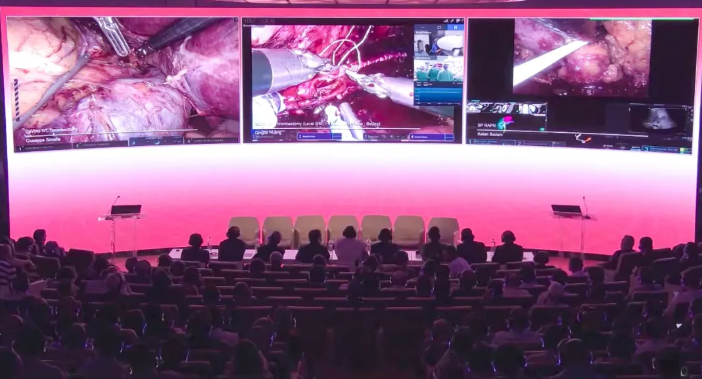
CILR has long focused on laparoscopic and robotic surgery in urology, artificial intelligence applications, and high-complexity surgical challenges — making it one of the most influential academic forums in robotic urology worldwide, often described by the field as the "Super Bowl of robotic urological surgery. A live surgical broadcast on this stage is not merely a technical showcase — it is a real-time, peer-to-peer assessment by the world's leading experts. To earn a place on the CILR live surgery program requires not only exceptional academic value and surgical complexity, but also the confidence that the surgical team, the robotic platform, the remote communication system, and the on-site coordination framework can withstand real-time scrutiny from the global surgical community.
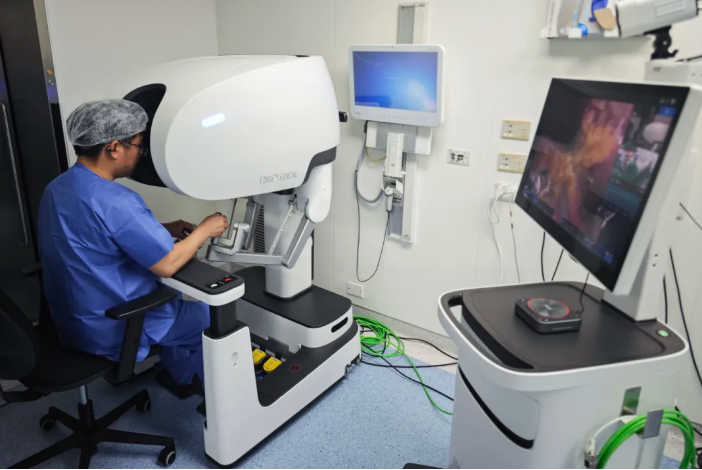
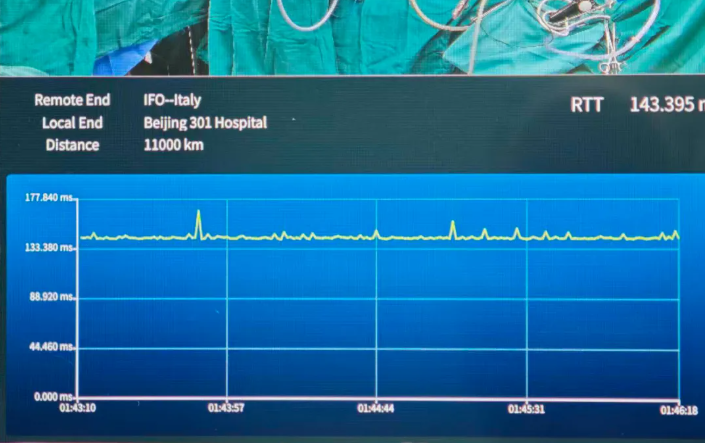
During the procedure, Professor Huang Qingbo operated with composure at the console in Rome, while the Edge Medical® robotic arms in Beijing responded with precision. Across approximately 8,200 kilometers of linear distance — and over 20,000 kilometers of bidirectional communication — the Edge Cloud® remote surgery system connected Rome and Beijing to a single shared "operating table." System latency measured approximately 143 milliseconds, delivering stable and fluid remote control that provided a solid foundation for complex vascular manipulation.
Renal cell carcinoma with IVC tumor thrombus is widely regarded as the "crown jewel" of urologic surgery. These procedures demand not only radical oncological resection, but precise management of the thrombus extending into the inferior vena cava — including vascular occlusion, thrombus extraction, and IVC reconstruction, all within a finite ischemic window. The IVC is one of the body's great vessels, flanked by critical structures including the liver, pancreas, and duodenum. Even a minor misstep risks catastrophic hemorrhage or injury to vital organs. This is among the most challenging procedures in urology even under conventional robotic conditions — and this surgery was performed across 8,200 kilometers between Rome and Beijing, adding a further dimension of complexity.
The team first achieved precise exposure of the IVC, right renal vein, and right renal artery, using intraoperative ultrasound to confirm thrombus location, extent, and vascular wall integrity. Following a "vessels first, tumor second" strategy, the team sequentially completed right renal artery control, IVC clamping, venotomy, thrombus extraction, endoluminal inspection, and IVC reconstruction — each step executed with meticulous precision.
As the IVC venotomy was completed, the thrombus extracted, and the vessel reconstructed — experts at the Rome venue and the global audience witnessed a defining moment together. Under remote conditions, the Edge Medical® robot responded with stability and precision. Every command from the lead surgeon was transmitted clearly and fluidly to the Beijing surgical team.
From Surgical Broadcast to Academic Dialogue
Presenting Chinese Surgeons' Technical Depth and Evidence-Based Thinking to the World
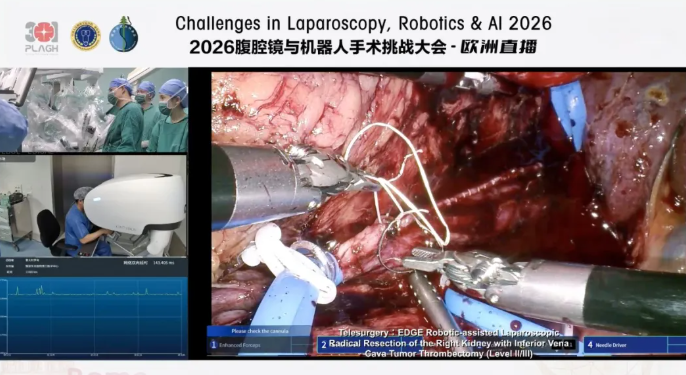
The significance of this procedure extends far beyond completing a world-first ultra-remote challenge — it brought a Chinese team's extensive clinical experience in complex renal tumor thrombus surgery to a world-stage forum for real-time academic exchange.
During the live broadcast, European and Chinese experts engaged Professor Huang Qingbo's team on multiple critical questions: Why prioritize the IVC? Is a preoperative filter indicated? How to assess IVC wall invasion — and if resection is required, which reconstruction technique should be selected? How does the team safeguard the patient during a remote procedure if an unexpected event occurs?
Drawing on Academician Zhang Xu's team's deep, long-standing experience in renal cell carcinoma with IVC tumor thrombus, Professor Huang addressed each question in detail — covering surgical approach selection, vascular control principles, thrombus management strategy, and emergency safety protocols.
From Learners to Leaders
Three Consecutive Breakthroughs Demonstrate Chinese Urology's Capacity for Innovation

Over a decade ago, when Chinese urological surgeons first appeared at CILR, they came primarily to learn from the international community. Today, Academician Zhang Xu's team returns to this world-class platform year after year — showcasing innovative surgical techniques, complex procedure capabilities, and landmark achievements in remote robotic surgery on behalf of Chinese urology.
In 2024, Academician Zhang Xu used the Edge Medical® robot in Rome to complete the world's first intercontinental ultra-remote human surgical procedure — demonstrating to the world that Chinese remote surgery had arrived. In 2025, Professor Ma Xin performed a live robot-assisted IVC tumor thrombectomy combined with radical left nephrectomy at CILR — showcasing Chinese teams' deep expertise in minimally invasive management of complex renal tumors with thrombus. Now in 2026, Professor Huang Qingbo takes the stage once more — elevating the challenge to an unprecedented level: "ultra-remote + complex oncology + great vessel reconstruction."
Three appearances. Three breakthroughs. From intercontinental remote robotic surgery, to live complex tumor surgery, to ultra-remote tumor thrombectomy with IVC reconstruction — behind these achievements lies years of dedicated Chinese clinical work in complex urologic oncology: driving the minimally invasive, systematic, and standardized evolution of renal cell carcinoma with IVC thrombus surgery. These milestones are a microcosm of Chinese surgeons, Chinese technology, and China's independently developed surgical robot stepping to the center of the world stage.
From Rome to the World
China's Innovation Opens a New Future for Remote Surgery
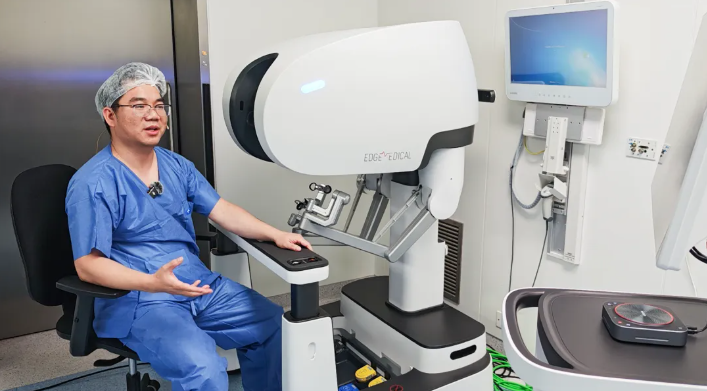
From Rome to Beijing — delivering exceptional surgical capability across mountains and oceans. This Rome–Beijing ultra-remote procedure challenged one of urology's highest-risk, most complex operations: renal cell carcinoma with IVC tumor thrombus. It validated the comprehensive capabilities of a surgical robot in a transcontinental remote environment — critical vascular manipulation, fine suturing and reconstruction, real-time imaging feedback, master-slave control responsiveness, and multidisciplinary team coordination. It demonstrated that remote robotic surgery has advanced beyond technical demonstration to a higher stage of complex clinical application.
Upon completion, the CILR auditorium erupted in warm applause, with multiple international experts offering high praise. That applause belongs to the systematic clinical strength built by Chinese urology over years of dedication. It belongs to the innovative power of China's independently developed surgical robot, continuously breaking through barriers. And it belongs to the new future that remote surgery is now opening.
From the CILR congress stage in Rome to the operating room at the PLA General Hospital in Beijing, the Edge Medical® robot delivered a commanding performance across a high-complexity intercontinental remote challenge. Looking ahead, Edge Medical® will continue to collaborate with clinical experts worldwide — advancing safety, stability, clinical standardization, and scalability of remote surgery — driving the transition from "technical breakthrough" to "clinical routine," and from "world's first" to "accessible to more patients," delivering higher-quality, more accessible precision surgical care to patients everywhere.
Chinese surgeons are making history on the world stage.
China's innovation is opening a broader future for remote surgery.

