News Center
Innovative Solution Provider for Minimally Invasive Surgery

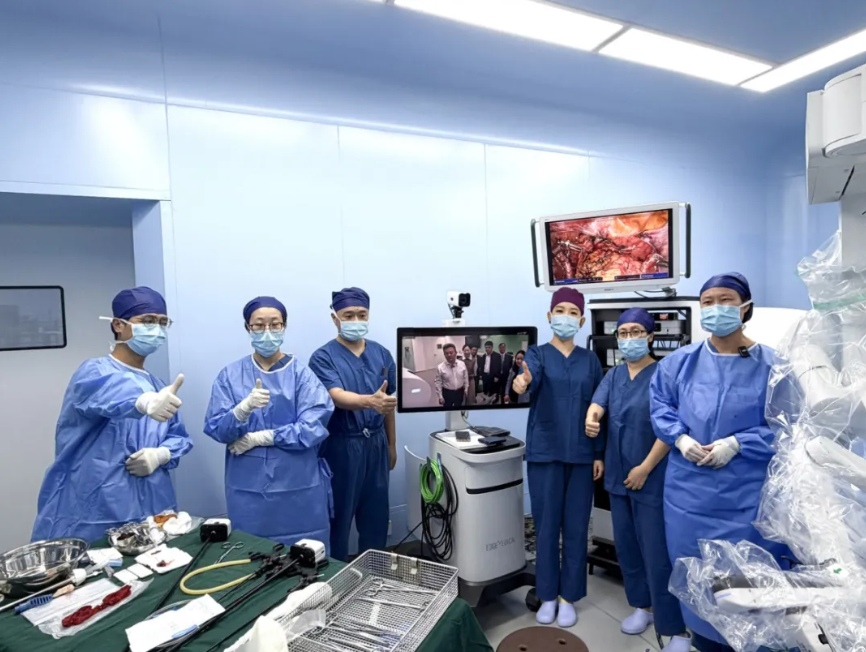
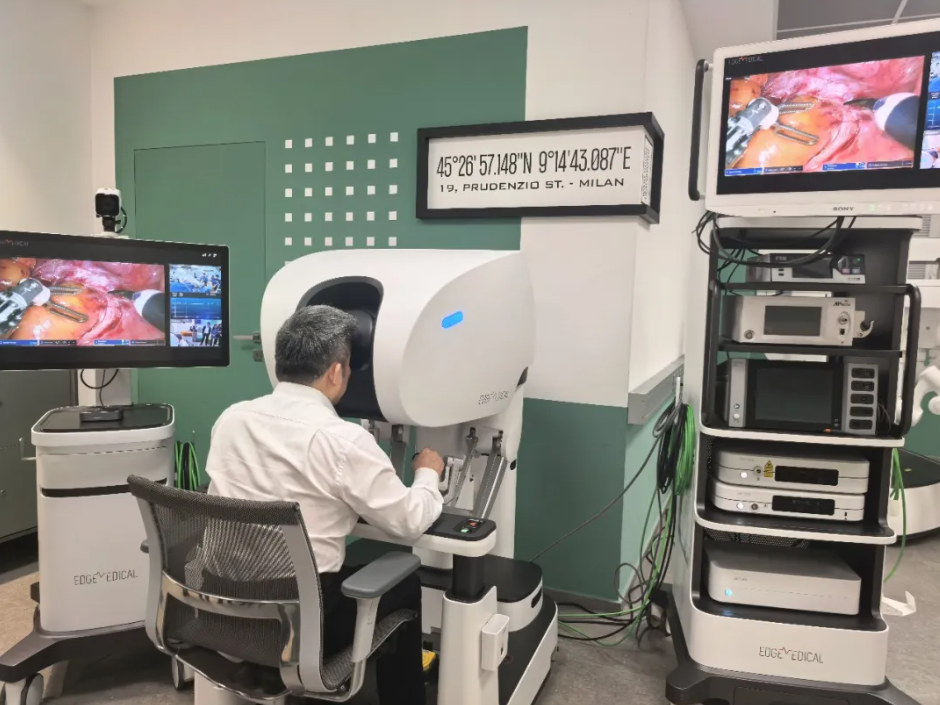
On 21 October 2026 Beijing time, a remote robotic surgery spanning Eurasia — connecting Milan, Italy, with Hangzhou, China — was completed successfully. Professor Wang Hui, Party Secretary of the Women’s Hospital, School of Medicine, Zhejiang University, from the T. Mohwinckel Robotic Training Center, used the EdgeCloud® Telesurgery System to remotely steer the Edge® Multi-Port Endoscopic Surgical Robot in the operating theater of the Yuhang Campus of the Women’s Hospital, nearly 10,000 kilometers away, and performed robot-assisted minimally invasive surgery on a patient with endometrial cancer and severe pelvic adhesions.
According to publicly available information, this is also the world’s first intercontinental remote gynecologic oncology surgery. Under intercontinental, ultra-long-distance communication conditions, and in the face of complex pelvic adhesions and demanding anatomy, Professor Wang Hui relied on the Edge® surgical robot’s high-definition 3D vision, its flexible biomimetic arms and the EdgeCloud® Telesurgery System’s stable control. Working in close collaboration with the clinical teams on both sides, he completed the critical steps — extrfascial total hysterectomy with bilateral oophorectomy, precise sentinel lymph node biopsy, and high-difficulty lysis of severe pelvic bowel and ureteral adhesions. This is not only another important advance in the clinical practice of Edge® remote surgery, but also a further demonstration of how China-developed surgical robotics is advancing into complex gynecologic oncology and pioneering new models of cross-border medical collaboration.
Nearly 10,000 kilometers: steering Hangzhou from Milan
The Edge® surgical robot completes complex gynecologic oncology surgery
The patient undergoing surgery had been diagnosed with endometrial cancer. Fifteen years earlier, she had undergone laparoscopic bilateral salpingectomy at the Women’s Hospital for bilateral pyosalpinx. Over the intervening decade and a half, tissue repair and remodeling left her pelvis bound by extensive severe adhesions: the rectum and sigmoid colon were densely adherent to the uterus and both ovaries, the normal anatomical planes were obscured, the ureters followed severely distorted courses, and the natural dissection spaces had almost completely closed. For endometrial cancer surgery, this pelvic condition means a substantially more difficult operation. The procedure requires not only standardized tumour resection and staging assessment, but also meticulous dissection through densely adherent tissue planes and accurate identification and protection of the ureters, bowel and major vessels — demanding precision from the surgeon and performance from the surgical platform.
Taking the patient’s condition into account, the expert team at the Women’s Hospital completed a thorough preoperative assessment and discussion and settled on an intercontinental remote robotic surgery plan, with Professor Wang Hui — who was in Milan on an overseas visit — serving as the remote surgeon and the patient-side team in Hangzhou assisting in real time. On the day of surgery, Professor Wang Hui sat at the Edge® surgeon console, observing the operative field in real time on the high-definition 3D display and, with both hands on the master manipulators, remotely driving the Edge® Multi-Port robotic arms in the Hangzhou operating theater.
Facing complex pelvic anatomy, Professor Wang Hui drew on his extensive experience in gynecologic oncology surgery, with the Edge® surgical robot’s high-definition 3D vision and multi-degree-of-freedom instruments, dissected the constricted adhesive space layer by layer, carefully freeing the inflammatory tissue along the course of the ureters, protecting critical anatomical structures and vessels, and completing the tumour resection and staging steps. Throughout the procedure, the two teams maintained continuous communication through the real-time audio-visual system, adjusting instruments and strategy as the operation progressed, so that the remote surgeon and the patient-side team worked in tight coordination.
The procedure was completed in under three hours. Professor Wang Hui successfully performed extrfascial total hysterectomy with bilateral oophorectomy, precise sentinel lymph node biopsy, and high-difficulty lysis of severe pelvic bowel and ureteral adhesions, with intraoperative blood loss of only about 50 mL, and every critical anatomical structure and vessel fully protected. After surgery, the patient recovered well under the attentive care of the medical and nursing team at the Yuhang Campus, with all vital signs and indicators stable and within target, and was discharged smoothly on postoperative day 5.
Connecting the world with technology, empowering clinical practice with collaboration
Let high-quality surgical expertise cross mountains and seas
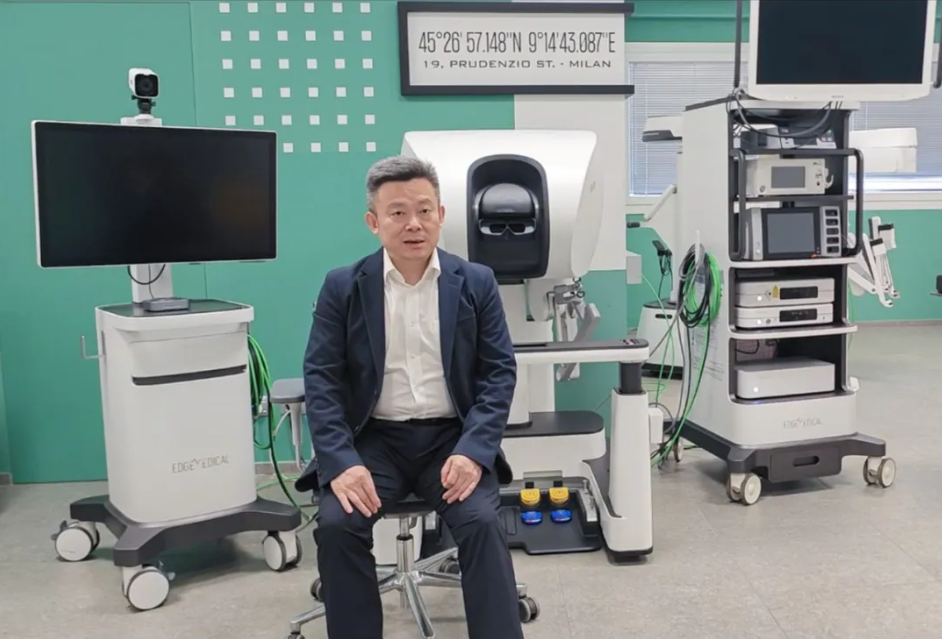
Compared with conventional robotic surgery, intercontinental remote surgery demands not only precise, agile and stable instrument control, but also rigorous performance in network communication quality, real-time image transmission, command response and system reliability over ultra-long distances. The EdgeCloud® Telesurgery System became the critical technical link that connected the two sites and supported the procedure from start to finish.
As a remote surgery solution developed in-house by Edge Medical, the EdgeCloud® is built around low latency, high fidelity, strong assurance and cloud interconnection, forming a complete remote surgery technology system. It enables physicians to operate a surgical robot thousands of kilometers away and provides the technical foundation for the clinical application, technical training and multicenter collaboration of remote surgery. In recent years, relying on the Edge® surgical robot and the EdgeCloud® Telesurgery System, Chinese surgeons have carried out a series of landmark intercontinental remote procedures.
In June 2024, the Edge® surgical robot supported Academician Zhang Xu of the PLA General Hospital in connecting remotely from Rome, Italy, to Beijing, delivering a live broadcast of ultra-remote cross-continental robotic surgery on a human patient and demonstrating the technical feasibility of intercontinental remote operation with a China-developed surgical robot. Since then, the Edge® platform has continued to take part in cross-border and cross-regional remote surgical practice, accumulating clinical experience across urology, general surgery, gynecology and thoracic surgery. The successful completion of this first intercontinental remote gynecologic oncology surgery from Milan to Hangzhou further extends the intercontinental remote clinical application of the Edge® platform to complex gynecologic malignancy surgery. Edge Medical will continue to work with clinical experts at home and abroad, advancing remote surgery from technical feasibility validation towards multidisciplinary practice, complex procedures and international collaboration.
At the same time, to secure the smooth conduct of this intercontinental procedure, the Women’s Hospital organized a multidisciplinary team. The team led by Chief Physician Shen Yuanming of the Department of Gynecologic Oncology, the team led by Chief Physician Wang Yinfeng of Gynecology General Ward 1 at the Yuhang Campus, the team led by Chief Physician Xu Lili of the Department of Anesthesiology, and the operating theater nursing team led by Head Nurse Wang Shanshan jointly completed the preoperative planning, contingency drills, network testing and intraoperative support, building a surgical safety-assurance system that is cross-regional and multidisciplinary.
After the operation, Professor Wang Hui, Party Secretary of the Women’s Hospital, said that compared with domestic remote surgery, this intercontinental procedure was even more challenging. The teams on both sides provided the technical and clinical assurance that allowed the surgery to be completed successfully. He added that remote surgery has strong prospects for further development, and expressed the hope that this technology could support more international medical collaboration in future, so as to keep accumulating cross-regional remote surgical experience and drive the technology further forward.

