News Center
Innovative Solution Provider for Minimally Invasive Surgery

From September 16 to 19, the 78th DGU took place at Messe Düsseldorf, bringing together more than 6,000 urologists, researchers, and healthcare professionals from over 40 countries. As one of the largest national urology congresses, DGU is an important forum for clinical exchange, education and innovation within the European urology community.
As the only Chinese laparoscopic surgical robotics company exhibiting at this year’s congress, Edge Medical showcased its independently developed Edge Multi-Port Robotic System.
A Challenging Robotic Procedure in Focus

Prof. Evangelos Liatsikos, Professor of Urology at University Hospital of Patras, Chairman of the European School of Urology, is internationally recognised for his work in endourology and robotic surgery and is closely involved in specialist training and continuing medical education across Europe. During the Semi-Live session, he presented a nerve-sparing radical prostatectomy with the Edge robotic system, based on a clinical case from Lefkos Stavros - The Athens Clinic, the first hospital in Greece to install an Edge system. Drawing on his extensive experience in robot-assisted urologic surgery, he shared practical observations from the procedure with the audience.
Nerve-sparing radical prostatectomy is one of the more technically demanding procedures in urologic surgery. Beyond achieving adequate oncological resection, the surgeon must carefully preserve the neurovascular bundles involved in urinary continence and erectile function wherever clinically appropriate. This requires a high level of precision, stable visualisation and fine instrument control, particularly when operating deep within the confined anatomy of the pelvis.
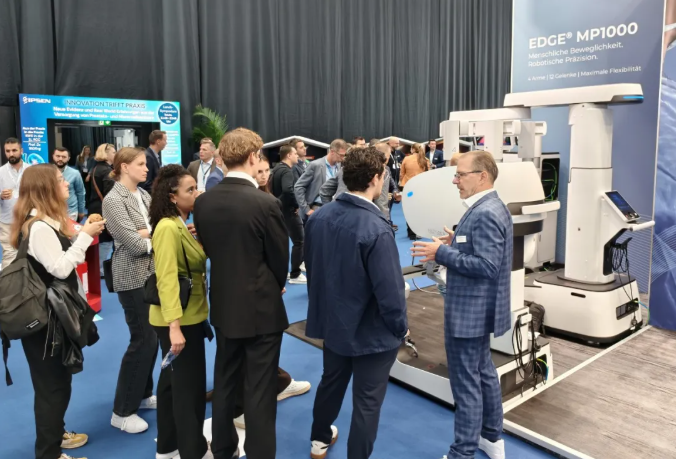
During the presentation, the operative field from the Edge robotic system was displayed on the main screen, giving the audience a detailed view of the dissection. High-definition 3D visualisation and depth perception helped distinguish subtle tissue planes between the prostatic capsule, Denonvilliers’ fascia and the prostatic fascia, supporting precise dissection around the neurovascular bundles. The layered dissection also demonstrated the fine tissue handling required for an “onion-peeling” approach to nerve preservation. The procedure progressed in a controlled and consistent manner, while the audience followed the key steps closely, with many attendees capturing moments from the session.
Prof. Liatsikos highlighted the system’s short learning curve and precise instrument tracking, and also drew attention to its native external 3D video output. With the external 3D display, the bedside surgeon can wear lightweight polarised 3D glasses and view the operative field with the same stereoscopic depth perception available to the surgeon at the console. In complex procedures requiring close coordination between the console surgeon and the bedside team, this shared 3D view can make communication more intuitive and support smoother teamwork throughout the operation.
Germany is one of Europe’s largest markets for surgical robotics, with clinicians applying rigorous clinical and technical criteria when assessing new technologies. Throughout DGU 2026, the Edge Multi-Port Robotic System was available for hands-on experience, attracting a steady flow of physicians who stopped by to learn more about the system. Following their trial sessions, many physicians commented positively on the system’s handling and stability, with some describing the experience as “beyond expectations.” Instrument responsiveness and visual clarity were among the features most frequently mentioned, and several visitors expressed interest in further discussions and potential future collaboration.
Edge Medical is among a relatively small group of surgical robotics companies to have independently developed platforms covering both multi-port and single-port robotic surgery. Its portfolio includes the Edge Multi-Port Robotic System, Edge Single-Port Robotic System, and an integrated multi-port and single-port robotic surgery system, all of which have received CE certification in the European Union.
This multi-port and single-port portfolio allows Edge Medical to address a broader range of surgical approaches and clinical scenarios, while providing hospitals and surgeons with greater flexibility across different procedural needs.
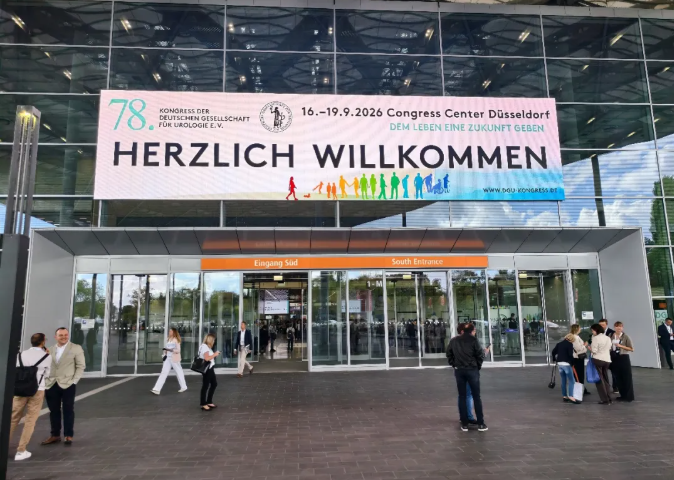
DGU remains an important forum for understanding how clinical priorities and technology adoption are evolving within European urology. This year’s programme reflected growing interest in areas such as artificial intelligence, robotic minimally invasive surgery and sustainable healthcare, alongside continued discussion around the wider adoption and cost-effectiveness of robot-assisted surgery.
Looking ahead, Edge Medical will continue working with clinical experts and partners worldwide to support the adoption of robotic surgery through clinical evidence, academic exchange and professional education. Our goal is to make advanced robotic surgery technologies accessible to more hospitals and surgeons worldwide, and ultimately to help bring the benefits of minimally invasive surgery to more patients.

